Exploring yoga’s roots and the many paths that shaped the practice we know today.
Today, yoga has traveled all over the world. Many people practice yoga for health, wellness, strength, flexibility, relaxation, or a deeper sense of connection. You might find yoga in a studio, at a gym, in a park under the sun, or even in more playful settings such as goat yoga, puppy yoga, or yoga at a brewery. Yoga continues to evolve in creative ways, meeting people where they are and inviting them into moments of presence, joy, and self-discovery.
In this section, we will take a journey back to ancient India, where the roots of yoga began. Like stepping onto a path through time, we will explore how yoga gradually developed through different periods of history, from early spiritual practices and sacred teachings to philosophical systems, physical disciplines, and the many forms of yoga we see today.
As we begin this journey, it is helpful to remember that the history of yoga does not fit perfectly into exact dates. Many teachings were passed down orally for generations before they were written down. Some texts were composed and revised over long periods of time, and scholars may offer different timelines depending on the sources they use. For that reason, the dates in this section are best understood as approximate guideposts rather than fixed boundaries.
Before the Vedas (Early India and the Indus Valley Civilization)
Before we enter the Vedic Period, let’s take a step even further back and look at the early world of ancient India. This part of history is like standing at the beginning of a long trail. We can see some signs, clues, and footprints, but not the full story yet.
The earliest ancestors of people in India were likely connected to early human migrations out of Africa. Some groups reached South Asia tens of thousands of years ago. Much later, ancient populations continued to move, settle, farm, trade, and mix with one another. Genetic studies suggest that South Asian ancestry was shaped by many layers of migration and cultural exchange over a very long period of time, including ancestry related to ancient Iranian hunter-gatherers and, later, Steppe pastoralist groups.1
One of the most important early civilizations in this region was the Indus Valley Civilization, also called the Harappan Civilization. It flourished mainly around 2600–1900 BCE, though its broader development began earlier and continued in different forms afterward. This civilization was known for its cities, planned streets, drainage systems, trade, craftsmanship, and seals carved with animals and symbols. Because the Indus script has not yet been fully understood, much of its spiritual and religious life remains mysterious.2
The Yoga Story
One of the earliest artifacts often linked to yoga is the so-called Pashupati Seal, discovered at Mohenjo-daro in the 1920s. The seal shows a seated figure surrounded by animals, including a buffalo, rhinoceros, elephant, and tiger, with two smaller deer-like animals below the seat. Archaeologist John Marshall interpreted this figure as “Pashupati,” meaning “Lord of Animals,” and suggested a possible connection to an early form of Shiva. Some have also seen the seated posture as a possible sign of meditation or yogic practice.3
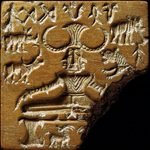
However, we cannot say for certain what this figure represents. Scholars have offered different interpretations, and the connection between the seal and yoga is still debated. Since the Indus script has not been deciphered, we do not have written records from this civilization explaining the meaning of the seal or confirming that yoga was practiced in the way we understand it today. Still, the image gives us a fascinating glimpse into the spiritual imagination of ancient India.4
So, before the Vedic Period, we are walking through a world of clues rather than clear teachings. We can see signs of ancient spiritual life, symbolic art, ritual, and possibly early meditative or ascetic practices. But we cannot yet clearly say, “This is yoga.”
The story becomes clearer in the Vedic Period, when sacred teachings began to be preserved through oral tradition in Sanskrit. From there, we begin to see the early language, rituals, and spiritual ideas that would later shape the long and evolving story of yoga.